The June issue of PASSOP WATCH is now available here. It includes stories on our latest report on the Refugee Reception Center, a letter from our Director on the xenophobic violence in POlokwane, our ZDP workshop in Masiphumelele, and an opinion piece on World Refugee Day.
Author Archives: PASSOP
Opinion Piece: World Refugee Day and what it means to be a “Refugee”
On 20 June, nations across the globe celebrated World Refugee Day, a holiday created by the United Nations in an attempt to bring awareness to those forced to flee their countries as a result of war, oppression, persecution and other human rights violations that threaten their safety. The UN Convention Relating to the Status of Refugees defines refugees as those “unable to return to their native land due to fears of persecution for reasons of race, religion, nationality and/or membership of a particular social group or political opinion.” According to the Internal Displacement Monitoring Centre, over 42 million people were displaced in 2010, an increase from 17 million displaced people in 2009. This massive increase is mainly due to the impact of “mega-disasters” such as the massive floods in China and Pakistan and earthquakes in Chile and Haiti. Even today, the long-standing debate continues over the definition of refugee, and therefore, who qualifies as a refugee.
It is unfortunate that this reality hampers the humanitarian efforts aimed at protecting and defending the rights of displaced peoples around the world. Additionally if an asylum seeker fails in his/her “refugee status determination”, he/she can be refused refugee status and be deported. In today’s world, one can be forced to flee for a multitude of reasons; economic and climate factors are beginning to dominate the “push” factors that result in the mass migration trends we are seeing around the world. Climate plays a central role in all of this. With droughts come increased food prices and economic strains on a country; drought and poverty can lead people to face starvation if they don’t migrate. In some countries there are corrupt leaders, there is a lack of political stability and elections are not free or fair, which leads people to flee from the resulting extreme poverty and hardship.
Sadly according to many countries, these forced migrants do not meet the UN definition of the term refugee and thus the UNHCR have no obligation to assist them. Their need for refuge is questioned-merely because of an absence of war—and their refugee status denied, which deportation becomes a veritable reality. PASSOP advocates for all people and, while we appreciate and support World Refugee Day, we do so with the entire global community of displaced peoples and forced migrants in mind, not just those lucky enough to be termed “refugee”. If governments continue to deny forced migrants the right to refuge and thus deny them refugee status, perhaps we need to enact a “World Forced Migrants Day” in order to globally conscientise their undeniable hardships.
PASSOP calls for patience during final stages of the ZDP
PRESS STATEMENT
For Immediate Release
PASSOP calls for patience during final stages of the “ZDP”
(Zimbabwean Dispensation Project)
PASSOP appeals to banks, employers, schools, health institutions and all stakeholders to be patient and respect the rights of Zimbabwean Permit Applicants.
There has been consistent denial of basic services and rights to thousands of Zimbabweans who are in the final stages of the adjudication process of their permits under the Zimbabwean Dispensation Project (ZDP).
We urge all stakeholders – including employers, banks, schools, hospitals, etc. - to note that Zimbabweans who possess a receipt of their application for a permit under the ZDP maintain their rights as legal immigrants. They have the right to work, study, or run businesses (depending on which permit they applied for) while their applications are still pending. This emphasis is important, as it was required that applicants of these permits provided proof that they were employed, studying or running a business at the time of application. Additionally they continue to have rights to emergency and basic healthcare, to access and utilise their bank accounts (keep them open), and to live and move freely within South Africa. Some of these rights are afforded to them by the Constitution, while others were allowed by the Department of Home Affairs in order to ensure that they would be protected during the adjudication period. This sensible and reasonable move was welcomed by civil society.
We call on all relevant parties to exercise patience and leniency in these cases, while the DHA wraps up their issuing of the withstanding work, study and business permits as part of the ZDP by the end of July. We cannot be certain if they will meet this deadline, but things are looking promising.
We are also pleased to be able to reassure the public and all stakeholders that, thus far, the Department of Home Affairs has been extremely consistent and transparent in the process of adjudication. Our monitors have been at the Wynberg Department of Home Affairs office, where the Zimbabwean Dispensation Project is being implemented and they have reported that (true to their word), the Department of Home Affairs is efficiently processing applicants and there have been very few “errors”.
for comment please contact project coordinators Langton Miriyoga on: 084 026 9658 or Caroline Theron on: 072 014 3540
PASSOP Calls on the ANC to Expel Xenophobic Councillors
ATTENTION: ANC Secretary General Cde Gwede Mantashu
COSATU Secretary General Cde Zwelinzima Vavi
SACP General Secretary Cde Blade Nzimande CC.
ANC President Cde Jacob Gedleyihlekisa Zuma
ANC Provincial Chair Western Cape Cde Marius Fransman
ANC Provincial Chair Limpopo Cde Cassel Mathale ANC Regional Chair Capricorn Cde Lawrence Mapuolo
RE: Urgent, open letter calling for ANC to expel councillors and members involved in violence against foriegners
Dear Cde SG Gwede Mantashe, ANC leadership and alliance leaders,
It has come to our attention that an ANC councillor has been implicated in the violence that lead to the brutal murder of a fellow African, from Zimbabwe, in Polokwane. This violence was shortly followed by the displacement of dozens of Zimbabweans. It is extremely concerning to us as, as there should never be any politician involved in violence, particularly xenophobic violence or senseless violence against foreign nationals from any other country, including Zimbabwe and Somalia. Using violence against foreign nationals to gain political support is a huge danger and must be stopped immediately. We must recognize that when politicians take advantage of frustrations between different groups (national, ethnic, racial, tribal etc.) to further political agendas, it has had catastrophic consequences all across the world.
This is not the first time and nor will it be the last time. After the November 2009 displacement of over 2,000 Zimbabweans in De Doorns there were similar allegations against the local Ward Councillor. In the same year Durban ANC councillor Vusi Khoza was arrested for his involvement in a “raid on foreigners” which resulted in the murder of two foreign nationals. During Khoza’s trial Zimbabwean national Eugene Madondo — a survivor of the violence — said Kohza, who was an ANC ward councillor at the time, was a “war general,” and had led the mob and instructed others to throw him out of the window.
This letter aims not to look back but to look forward. We are under no illusions regarding the complexities involved in dealing decisively with the councillors who perpetrate violence against foreigners; it is a sad reality that communities hold the perpetrators of xenophobic violence and violence against foreign nationals in high regard. This latest violence is concerning to us as it occurred so closely to our recent, peaceful, and successful Local Government Elections. We have to ask: did this councillor undertake to “deal harshly” with foreign nationals during his election campaign? Sadly it seems clear that any councillors involved in such violence will not be held to account by their electorate, and thus we believe leaders must ensure quick, strong and fearless intervention.
There can be no room for leniency when dealing with these “grassroots” politicians if they have involved themselves in inexplicable behavior. If we allow for such conduct we could soon find ourselves facing other forms of populist hate crimes and violence in the months and years to come. We must realise that the same prospects for increased popularity can be found through the targeting of homosexuals, other races and tribes. Such cheap politics must be nipped in the bud, before it escalates to uncontrollable levels.
We recognize and welcome the statements by the SACP, the ANC and the speech by the ANC Deputy President Kgalema Motlanthe — all of which condemned this recent senseless violence. We also recognize and welcome the efforts by government to run anti-xenophobia campaigns, particularly the establishment of the cabinet task team shortly before the end of the 2010 World Cup. It is our view that the efforts by Minister Nathi Muthethwa and the cabinet task team, supported by the police and SANDF, successfully deterred the rumoured “after world cup” xenophobic violence. The ANC also led by example, holding protests against xenophobia in township communities such as Gugulethu to openly demonstrate that xenophobia is not something the congress supports.
However, unless a politician suffers politically he/she will not be deterred from resorting to such reckless populism in the future. We humbly call upon the ANC to suspend any councillors involved in Polokwane’s senseless violence against foreigners, pending the outcome of investigations. If there is any conclusive evidence we ask that you expel them as soon as possible, as we cannot tolerate this reckless behavior.
We also appeal to the ANC to ensure that all its branches are engaged in Polokwane, not only to hear the members’ concerns, but also to inform them that such behavior will not be accepted by the ANC. Furthermore, we encourage the ANC to ensure that the congress’ newly elected councillors are educated on how to avoid violence, and to understand the ANC’s condemnation of violence against vulnerable groups, including foreign nationals.
Finally, we appeal to the ANC to suspend any and all of its members who are accused of encouraging violence against foreign nationals, and expel them if investigations produce evidence of their complicity.
These loose cannons are tarnishing the image of the ANC and its affiliates. We ask you to intervene immediately, both to preserve the party’s reputation as well as ensure the safety of the foreign nationals living within our borders.
Yours respectfully,
Braam Hanekom
PASSOP
Photo gallery test
New anti-xenophobia project launched
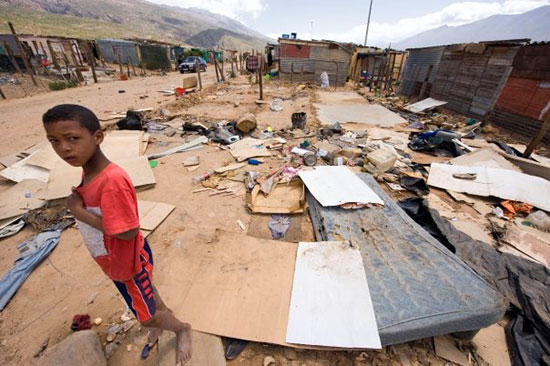
New anti-xenophobia project launched
Go to http://www.passop.co.za/programmes/anti-xenophobia-help-desks for more information.
ZDP Monitoring Report published
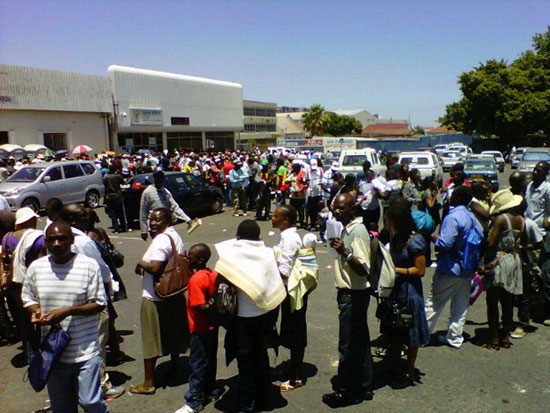 PASSOP’s monitoring report of the implementation of the ZDP was released on March 10th. To download a copy of the report, click on the following link: Zimbabweans failed by Zimbabwe - The ZDP Monitoring Report.
For information on the Zimbabwean Dispensation Project Monitoring, please visit http://www.passop.co.za/programmes/zimbabwe-dispensation-project-monitoring.
PASSOP opens new headquarters
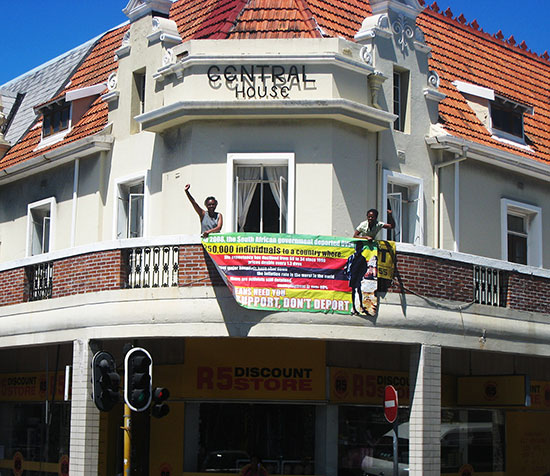
New PASSOP HQ
PASSOP has moved to a new headquarters office in the centre of Wynberg. The move is part of a process of rapid expansion that is now in full swing. PASSOP was previously operating out of Braam Hanekom’s mother’s house.
The new headquarters is ideally located on the Main Road close to the Wynberg Home Affairs Office and the Magistrates Court. It will greatly increase PASSOP’s capacity, in terms of both the amount of appointments we can take and the amount of staff and volunteers we can hire. With the new headquarters in place, we are ready to take on the many issues at hand and are sure that 2011 will be a big year.
The address of the headquarters is 31 Church Street, (corner of Main Rd and Church St.) in Wynberg and our new office telephone number is 021-820 4664. Come by and have a look at our new place – we are open Monday – Friday from 9am to 5pm.