Remittances research featured on CNBC

Featured

The PASSOP research report on remittance flows from South Africa to Zimbabwe, ‘Strangling the Lifeline’, has made headlines since it was launched last week. The author of the report, our Programme Coordinator David von Burgsdorff, was interviewed on CNBC Africa’s Beyond Borders show on Wednesday evening - the full interview can be viewed here. The findings of the report were also featured in numerous other articles, ranging from Bloomberg News, The Business Day, UK-based SW-Radio Africa, to SABC.

We are happy that the findings have been widely disbursed and have raised awareness around this important issue. Indeed, remittances flows from South Africa to bordering countries is an area where there is huge potential for improvement in policy-making. The impact of more forward looking policies that leverage these remittance flows would surely be substantial for poverty alleviation and development in Zimbabwe and other neighbouring countries. We will keep pushing for the recommendations we have put forward to be translated into reality.

Media Watch: April 7-13th

Here is an update of relevant news from South Africa and the region from the past week.

South Africa News

Refugees attacked at Home Affairs office in Pretoria - Tuesday 10 April, a security official employed by Home Affairs attacked refugees with a sjambok while they were waiting in line outside the Home Affairs (HA) office in Pretoria. HA has not been renewing documents because they ran out of the specific paper. The situation has turned drastic as refugees start paying bribes to officials who claim to be able to fast track their documents.

South African government owns up to invalid deportations - After the deportation of 125 Nigerians on the basis of false allegations of documentation fraud, the government has finally issued a formal apology. Nigeria accepted the apology, though some tensions remain.

Home Affairs blames its incompetence on immigrants - Mkhuseli Apleni, director general of Home Affairs, was recently accused of making xenophobic comments about foreign nationals. Apleni has claimed that foreign nationals detained at the Lindela Detention Centre lie about their identities and birth countries, delaying their deportation and extending their period of detention. The LRC has called these inaccurate comments “inappropriate and unbecoming of a high level government official.”

Home Affairs continues to refuse to comply with court orders - Lindela, a large holding facility for suspected undocumented migrants, has a well-earned reputation for human rights abuses. Many detainees report that court orders compelling the Department of Home Affairs to release them are being ignored. The facility is hugely overcrowded because detainees are often held beyond the regulatory time limit of 120 days. DHA Director General Apleni did not deny his department’s refusal to comply with court orders.

Home Affairs fails to meet the needs of asylum seekers - The Department of Home Affairs is struggling to meet the needs of asylum seekers, as its top official recently admitted. Fights and stampedes are commonplace in lines outside offices that accept asylum applications. The UN High Commissioner for Refugees has expressed concern over how the system in South Africa creates difficulties for those escaping violent and oppressive conditions. The system is fraught with frequent delays, backlogging, inefficiency, and invalid refusals to grant asylum.

Ncube accuses South African immigration officials of racism - After being detained without valid cause at OR Tambo International Airport, newspaper publisher Trevor Ncube tweeted “it’s time South African immigration stopped assuming every black African coming into the country is a desperate criminal”. South African immigration officials have been repeatedly accused of racism, xenophobia and classism.

Zimbabwe News

Mugabe’s denies health emergency reports - Robert Mugabe returned from Asia Thursday, amongst rumors that he had experienced a health emergency. During the past 16 months, the President has flown to Singapore 10 times to receive medical treatment for prostate cancer. Rumors of ill health spread after a Nigerian preacher had a prophecy that Southern African leaders faced imminent deaths.

Zimbabwe stops subsidy agricultural inputs in favor of a market-based financing approach - The new scheme by the Agricultural and Finance ministers centers around a “cost recovery” scheme and seeks to offset food insecurity. The finance minister will make $5 million available to farmers for fertiliser and seeds. An additional $15 million of agricultural inputs will be carried over from the summer season. Analysts say that this plan is not sustainable because farmers will need to find working capital on their own, which, in the Zimbabwean environment, is hard to come by.

Teachers pressure government to include them in indigenization and economic empowerment program - Tendai Chikowore, president of the Zimbabwe Teachers Association, called for inclusion in the economic empowerment program, asking the government to extend the services to civil servants. Critics of this demand, including the president of the Progressive Teachers Union of Zimbabwe, said that the payment of salaries should come before demands for empowerment.

DRC News

President Kabila calls for military defectors to rejoin - Soldiers loyal to former rebel leader Ntaganda defected from the DRC military last week in answer to a call from Ntaganda to join him. Ntaganda wanted the soldiers to bolster his personal protection as the ICC calls for his arrest to face charges of war crimes. Violence is not anticipated due to the military advantage held by Kinshasa, and President Kabila went to Goma in eastern DRC to pressure the soldiers to return.

Malawi News

Joyce Banda sworn in as President after the death of Mutharika - President Banda, Malawi’s first female president, was sworn into office Tuesday 7 April, after two tense days where the government delayed announcing Mutharika’s death. In less than a week, President Banda fired the police chief, information minister, and a top state broadcaster. The President is seeking to normalise relations with donors and to get Malawi back on track.

Protest: Serve us, don’t beat and deport us!

Featured

Press statement for immediate release:

‘Serve us, don’t beat and deport us’

PASSOP will be joining hands with Asylum seekers tomorrow and protesting against the use of violence by government contracted staff. While we cautiously welcome some of the latest undertakings made by South African Department of Home Affairs, we feel that much more needs to be done.

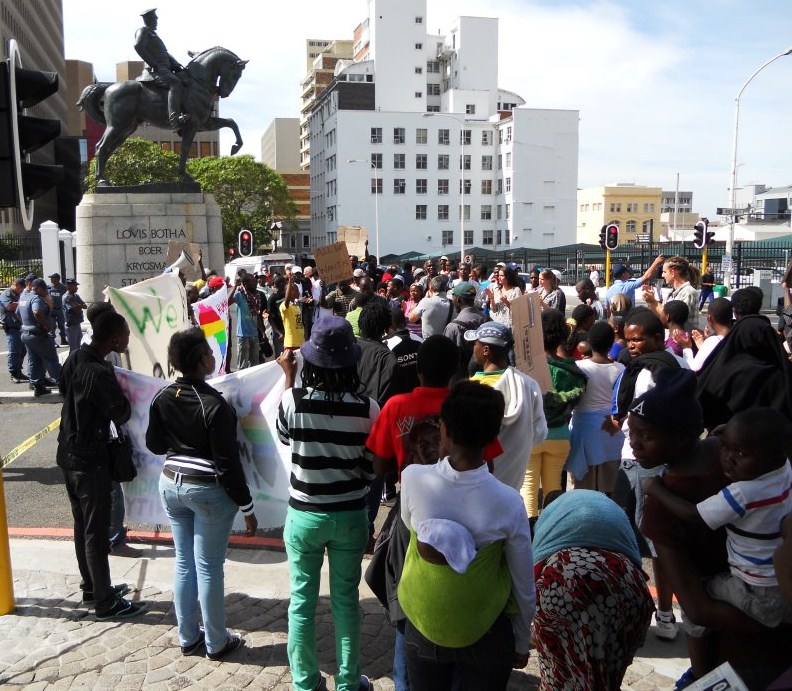
The protest will be held at the Cape Town Maitland Refugee Reception Office tomorrow, Friday 13th of May, from 10:30 to 12:00

The protest dubbed ‘serve us, don’t beat and deport us’, aims to exert pressure on the Department of Home Affairs to further improve its services to refugees and asylum seekers. Our protest has been provoked by the horrific treatment of asylum seekers in at the Refugee Reception Office in Marabastad and the on-going violent treatment at refugee reception centres across the country. While acknowledging the undertakings made today at the weekly media briefing by Home Affairs Director-General Mkuseli Apleni, we want those who authorized the use of sjamboks on queues and those who assaulted asylum seekers to be held accountable.

Our protest comes at a time when there are mounting problems at the refugee reception centres including poor service, delays in the issuing of documents, frequent “running out of paper and forms”, poor queuing conditions and prohibitive policies and practices among other factors which inhibit the documentation of immigrants. In light of the many problems at the Refugee Reception Offices including the Cape Town Refugee Reception Centre and other parts of the country, we will also express our concern about the resumption of deportation of immigrants by the South African government at this point in time. We remain steadfast in opposing the inhumane practice of deportation without giving immigrants in the country adequate opportunity to be documented.

We believe deportations will not stop the influx of immigrants into South Africa, but are rather a waste of taxpayers’ money. Instead of deporting people, our desire is to see the Department of Home Affairs making efforts to create an environment conducive for the documentation of immigrants.

For comment, please contact, Langton Miriyoga on 084 026 9658 or Braam Hanekom 0843191764


‘Strangling the Lifeline’ - PASSOP Report on Remittance flows from SA to Zimbabwe

Featured

PRESS STATEMENT

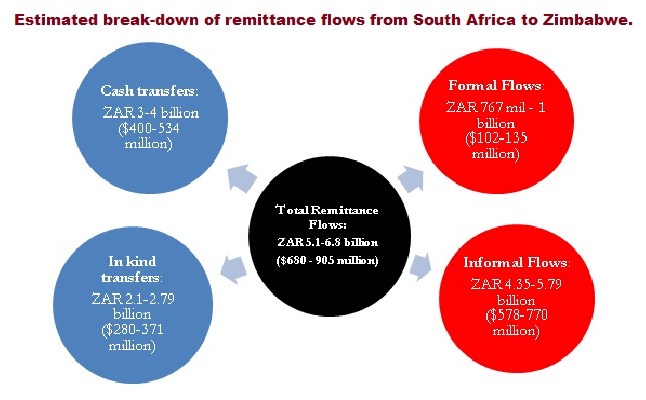
Cost of sending remittances from South Africa amongst highest in the world. Between 70-80 per cent of the ZAR 5.1-6.8 billion (US$ 680-900 million) estimated to have been remitted in 2011 was sent through informal channels.

These and other findings of a new PASSOP Report on remittances to be submitted to the South African Reserve Bank and the Department of International Development and Cooperation.

A new research report by PASSOP, “Strangling the Lifeline - An analysis of remittance flows from South Africa to Zimbabwe”, has found that 91% of Zimbabwean migrants in South Africa send money home regularly (these transfers are called remittances). The report, based on interviews with 350 Zimbabwean migrants - the largest sample size on the issue in the last five years - also found that the average amount remitted by migrants was almost a third of their monthly income. Taking into account that an estimated 1.5 - 2 million Zimbabweans have emigrated to South Africa over the past decade, the report estimates that ZAR 5.1-6.8 billion ($700-850 million) were remitted in 2011, making remittances one of the most important sources of foreign currency inflows for Zimbabwe. Remittances are relied on to sustain the livelihoods of up two-thirds of Zimbabwe’s remaining population. South Africa’s renewed practice of mass deportations is therefore a serious threat to the livelihoods of thousands of families in Zimbabwe who are dependent on remittances, the report goes on to argue.

Another interesting finding of the research report is that roughly three quarters of migrants prefer using informal channels (bus drivers, friends, etc.) to remit money, rather than formal channels (banks or money transfer operators such as MoneyGram or Westsern Union), despite the lack of reliability and inefficiency of informal channels. These informal flows are unrecorded, and therefore the size of remittances flows has been hardly known and scarcely reported on in the past.

Perhaps the most surprising finding detailed in the report is that despite the proximity of Zimbabwe, and despite the large market that exists for remittances, the cost of sending remittances from South Africa to Zimbabwe is amongst the highest in the world. The average cost was found to be 12-15% of the amount remitted - the costs in comparable corridors, such as Mexico-US are much lower, at 3-5%. The implication of this is that the amount of money that actually reaches families in Zimbabwe, and hence the impact it has on poverty reduction and development, is much lower than it could be.

If the development gains for Zimbabwe are to be maximised then the ‘formalization of remittance flows’ must be fostered through the implementation of a number of key reforms. The report cites a list of recommendations to reduce inefficiencies, bring down costs and improve accessibility of formal channels, as well as facilitating flows and leveraging their development impact by providing the appropriate channels, financial education and effective incentives to migrants.

Perhaps contrary to initial impression, the report argues, it is in the interest of the South African government to facilitate the formalization of remittance flows. Rather than increasing the volume of flows, the effect would be to make flows more transparent and to increase the liquidity and efficiency of the financial sector in South Africa. Thus, remittances from South Africa to Zimbabwe represent a huge source of untapped potential for development on both sides of the border that is currently being mitigated by high transfer costs and impeded by stringent and inefficient regulations.

If the formalization of remittance flows is pursued comprehensively, remittances could realise their potential and play an invaluable role in the reconstruction of the Zimbabwean economy. This, in turn, is the only way to address the high currently high level of Zimbabwean migration to South Africa.

The full report will be published at a launch in Cape Town (Idasa House, 6 Spin Street) tomorrow, Wednesday April 11th at 11AM. The author of the report, David von Burgsdorff, will be joined on the panel by Professor Brian Raftopoulos and Mr. Braam Hanekom. Members of the media are invited to attend. The full report is available here.

For more information or comments contact: David von Burgsdorff (Programme Coordinator) 074 660 2583

Joint Press Statement: Social grants extended to vulnerable refugees

Joint Press Statement: PASSOP and Scalabrini Centre Welcome Social Grants for Vulnerable Refugees

Passop and Scalabrini Centre welcome the recent amendments to the Social Assistance Act 2004. As South Africans, by extending eligibility for social assistance to refugees we have taken an important step towards helping more desperate and vulnerable people living within our country. Not only will these amendments assist countless impoverished refugees, it will also make South Africa a better place to live for all citizens. People who live in abject poverty, without any assistance, must find a way to support themselves and their families. Because of this, they are often forced to accept low wages and poor working conditions out of desperation. By extending social assistance to more people and diminishing their desperation, we not only improve refugees’ lives but also the lives of all workers in South Africa. In this way, all of South Africa benefits from these amendments.

Passed on 3 March 2012 and now taking effect (since 1 April 2012), the amendments effectively extend eligibility for social assistance to refugees living in South Africa. As long as refugees maintain their legal status, they are eligible for social assistance grants. This includes the children of refugees as well. However, if the parent or primary caregiver of a child ceases to be a refugee under South African law, then they are no longer eligible to receive a social assistance grant.

Click here to view the new regulations.

For comment, please phone Braam Hanekom at 0843191764 or Miranda Madikane at 0833803572.

Press Statement: PASSOP disappointed over Zille’s allegation that South Africans are xenophobic

Press Statement - For Immediate Release

PASSOP concerned and disappointed by Premier Zille’s “refugee” tweets and allegations that South Africans are xenophobic.

When we were notified that Premier Helen Zille had tweeted a comment referring to children from the Eastern Cape as refugees, we expected her to simply apologise and withdraw from such remarks. We did not want to allow her reckless tweet to enter into the debate over who is “South African”, who is a refugee and who is an immigrant. In fact, to highlight the misuse of the term, our director Braam Hanekom jokingly replied to her tweet by tweeting: “that’s a very generous definition of refugee, please get the DA to adopt it as policy”.

In a country where the vast majority of refugee status applications are rejected she decided to call even South Africans refugees. We were so confused by what appeared to be a mistake, but to our surprise, despite a public outcry and even international media attention, she continued to argue that they were refugees.

We chose not to enter into the debate, but following these latest remarks - (“Since South Africans are so profoundly xenophobic, they regard the use of the term “refugee” as an insult, says Democratic Alliance leader Helen Zille.” Businessday written by Bekezela Phakathi (Link- http://www.businessday.co.za/articles/Content.aspx?id=168481) ) - we have decided to break our silence on the matter.

Premier Zille indeed has failed to accurately use the term refugee. She also made a serious misjudgment when she recently blamed concerned South Africans of being xenophobic for not wanting to be called refugees in their country of their citizenship. It is incorrect to say that someone is against foreigners or xenophobic because they do not want elected leaders in a democratic country that many fought and died for to call them refugees. We do not accept the Premier calling South Africans xenophobic and we do not accept that people who historically were restricted their freedom of movement are called refugees when they move between provinces.

We are disappointed by the reckless remarks and are concerned that they may easily fuel both racial tensions as well as xenophobic tensions. The premier is certainly saying that people of a certain province who happened to be “black” (in our apartheid trained terminology) should not be allowed to leave and come to a province, which is predominantly “coloured”. This is a fair assumption considering that the premier opened this debate when she was tweeting about tensions in Grabouw, which were divided along race and she was certainly referring to impoverished “black” children who were in her province from the Eastern Cape.

In the interests of human rights, we call upon her to apologise and to reconsider her position. Her statement is fueling tensions, and could undo much work that has been done to dissipate them since 2008’s xenophobic outbreak. Not only do we, but certainly the vast majority of South Africans want to build a country that does not see race and does not judge people based on their family name or country of nationality.

For Comment please call: Anthony Muteti – 0843510388 or David von Burgsdorff-0746602583

Immigrants march to Parliament in protest to demand papers

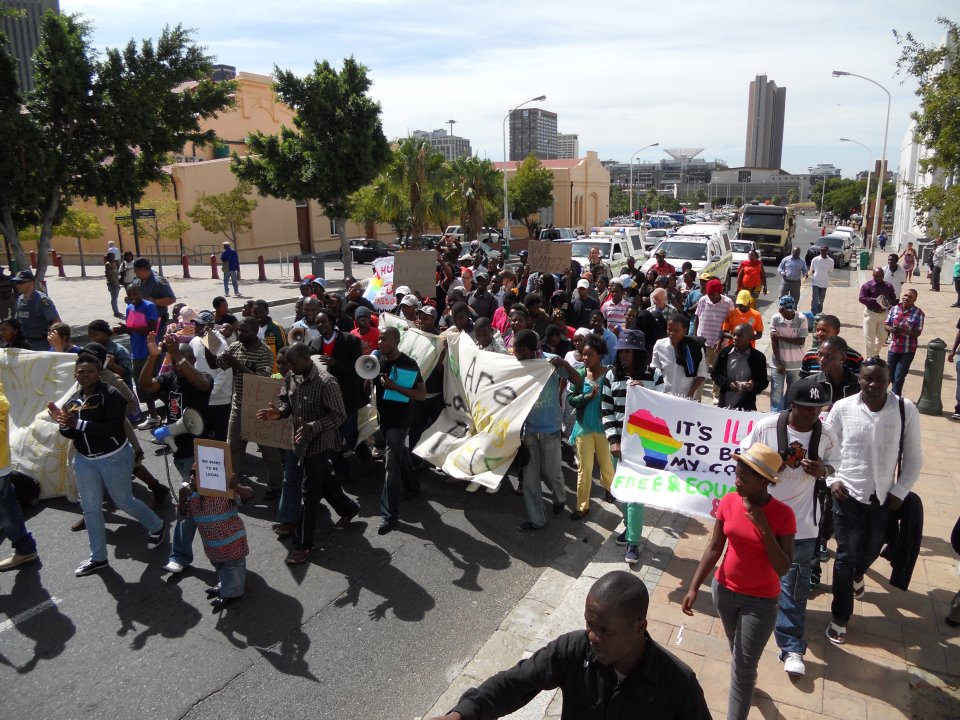
Around 150 PASSOP members, immigrants, asylum seekers and activists yesterday marched to Parliament to express their desire to get documented.

There is a common misconception that ‘illegal’ immigrants choose not to be documented. In the eyes of many, their alleged defiance of the rules justifies that they should be deported. This misconception also spawns the widespread anti-immigrant sentiments.

In fact, the vast majority of immigrants in South Africa want to be documented - the Department of Home Affairs just makes it extremely difficult for them to do just that.

At a time in which immigration raids have begun all over the country, and tensions in many communities have been on the rise, the march yesterday was meant to highlight this important issue.

The assembled immigrants expressed their frustration that they are viewed as ‘illegal foreigners’ that ‘choose not to be abide by the laws’. As one protester put it: “I am an immigrant without documents - even though I have tried and tried to get documented. I am not a thief, I am not a criminal, and I am tired of being treated like one. ”

Another added “I am teacher, with 20 years of experience in Zimbabwe, and here, I am not allowed to work. There are thousands of schools in South Africa that don’t have enough teachers, and still, they don’t let us work. Why?”

It is no exaggeration to say that South Africa currently no policy in place that acknowledges the reality of migration in Southern Africa. The only people who are able to attain work permits are those holding PhDs or other advanced qualifications. Everyone else, from teachers to nurses to farm workers, are left out.

South Africa can gain a tremendous amount by giving these immigrants a chance to work legally, including much-needed skills transfers, productivity growth and increased economic output, to name just a few.

Instead of doing this, South Africa’s policies in the past and at present have given most migrants no other option but to be undocumented. Such a policy is short-sighted and unhelpful, because it only increases migrants’ dependence on state resources and deprives South Africa of the huge developmental potential that migration presents.

The bottom line is that migration is a reality that is here to stay. It can either be dealt with in a reactionary way or it can be strategically managed to maximize its development potential for both South Africa and its regional partners. The government no doubt needs to move from the former to the latter.

Immigration policies need to move from being exclusive and reactionary to being inclusive, progressive and, most importantly, acknowledge the realities on the ground. Only in this way will South Africa be able to reap the development potential of migration and live up to its regional responsibilities.

PASSOP aims to work hard to stimulate constructive debate around these issues and advocate for these changes in the coming months leading up to the ANC Conference in Mangaung in July.

Opinion piece written by PASSOP Programme Coordinator, David von Burgsdorff.

Press Statement: ‘We want to be documented’: Immigrants march to Parliament today

FOR IMMEDIATE RELEASE

PASSOP members, immigrants, refugees, asylum seekers and activists will be marching to Parliament today express their strong desire to get documented.

The absolute majority of immigrants in South Africa want to be legal and want South Africans to know this. Unfortunately, to gain access to refugee centres remains extremely difficult and we want the people to understand this. It is clear that the Department of Home Affairs has greatly improved their services at home affairs offices across the country, but sadly the conditions at the refugee centres remain inadequate. In addition, except for the recent Zimbabwean documentation project, the Department of Home Affairs has not yet provided less wealthy undocumented immigrants an opportunity to get documented.

We believe that the situation in many areas is tense at present, with high levels of crime, frustration over access to basic services, unemployment and the many other complications that South Africa faces. These frustrations have led people in communities to resort to violent protests and sadly even barbaric mob justice. We want communities to understand that immigrants are trying their hardest to become documented. An immigrant without documents is not a thief, and is not a criminal.

The protest will leave Kraizergracht at 13:00 and march to Parliament.

For more information or media enquiries please contact: Langton Miriyoga on 084026965 or Braam Hanekom on 0843191764.

Press Statement: Inhumane and unjust immigration raids continue

PRESS STATEMENT
FOR IMMEDIATE RELEASE

CAPE TOWN - PASSOP and Gift of the Givers jointly condemn the inhumane and unjust practices of several SAPS and Home Affairs officers committed during an immigration crackdown. We express deep concern about the racist, xenophobic policies and attitudes towards people when investigating their documentation status.

PASSOP fully supports and endorses the Gift of the Givers and Mr Sablay in their laying an ICD complaint with South African Police Service. The Gift of the Givers feels strongly that no human being should be treated in such a way, whether or not they are a citizen. PASSOP and Gift of the Givers are shocked and disappointed at the manner in which immigration raids are being conducted. We will be contacting the Provincial Commissioner Lamoer about the behaviours of the SAPS in this incident and will be requesting a meeting to ask for him to intervene on this issue.

On 13 March, Jainudien Sablay was walking to shop in Rylands with his father when they were stopped by a member of the SAPS Special Task Force and Home Affairs’ Immigration Department. When they asked for identification, he provided his student card and ID number – but they rejected it, calling him Pakistani. Since their house was only five minutes away, Jainudien’s father went to retrieve another form of identification. Meanwhile, nearly forty jeering police and immigration officers physically and verbally intimidated Jainudien before violently throwing him into the back of a police van. He has said that “I feel in this new South Africa we are still treated like dirt… I am not a criminal to be treated like this.” Pass laws were a hallmark of Apartheid South Africa; their legacy should not mar the new South Africa. Following the experience, he had to seek medical care and his whole family was traumatized by the ordeal. Mr. Sablay’s family has been in Cape Town since the 1800s. He speaks English and Afrikaans and is a student at the University of the Western Cape currently doing his honours in Industrial Psychology, if this could happen to him, it could happen to anyone.

This incident is just one example of the alarmingly frequent racist violations of constitutional and human rights by SAPS and Home Affairs officers. These unjustly-conducted immigration raids have been happening more and more around Cape Town. Is this the South Africa we dreamed of and aspired to? Do we wish to live in a society where we are all vulnerable to arrest if we forget or lose our I.D. documents? There has clearly been no respect for a human being’s constitutional rights. The fact that this person is a citizen only serves to further highlight the flaws in how the deportation process is being implemented.

Contact:

Gift of the Givers, Gawa Sayed, 083 6613035 021 638 7909

PASSOP, Braam Hanekom, 084 319 1764

New list of ZDP Permits from March now available

Below is the most recent list of new ZDP permits - as of March 14th 2012. It includes all permits published so far in MARCH. These permits are ready for collection at Bellville Home Affairs. We will be publishing more names later this week.

The list is organised in alphabetical order.

If your name is not on this list, the list from February can be viewed here; those from January are here and the lists for last year’s permits can be viewed here or here.

If you have any questions, please don’t hesitate to call our office at 021 762 0322.

SURNAME INITIALS PASSPORT NUMBER
BENHURA F AN822387
BERE E.T CN159860
BHARU F CN080985
CHAMUNORWA N BN903211
CHASAYA M AN545803
CHESUNDA N CN045794
CHIBAYA W BN011978
CHIDEMO P.H CN144728
CHIDHUMO M CN084412
CHIDODO X CN472968
CHIFAMBA C.A AN567875
CHIGWIDA M BN684009
CHIKATI C CN080275
CHIKOMBA S BN081188
CHIKUMBIRIKE A.R AN852124
CHIMBIRA G CN499410
CHIMBIRO J BN124749
CHISAHWIRA J AN944407
CHIVASA I CN151276
CHIZEMA P CN066318
DENDERA E BN034383
DENHERE T BN189079
DUBE M CN089448
FAMBI H BN967056
GARANDE F CN089144
GOBOZA B AN800110
GOMBIRO K.L AN526735
GONZO C AN515266
GUTUSA S CN217881
HAMADZIRIPI B BN118085
HLERE E CN139058
JAVENGWA L CN062871
JIYA J CN078013
KAHARI F BN085997
KAPFUDZA P BN092803
KATANDIKA K.N CN077280
KOKOTA T BN993740
KONYANA G.G BN869876
KUDZOTSA F CN066419
KUWANDIKA K CN416713
KUZU M BN445588
LAKINZI V BN876849
MABALEKA V AN620280
MABENA M CN068240
MABWE P AN621745
MACHEKANO V CN148526
MACHIPI P CN067198
MADONDO T.F CN600002
MADWEKO M AN606473
MADZENENGA M CN061356
MADZI F CN130466
MADZINGA P.T BN054538
MAGUNDE C BN588366
MAHAMBAYEDWA J CN066278
MAJONGA F.M CN066484
MAJONI M CN230479
MAKAKA B CN434508
MAKANDA S CN066417
MAKANDISE V BN605082
MAKWARIMBA N CN154476
MANANA A AN831433
MANDIMUTSIRA T CN096721
MANDUNYERA R CN038567
MAPFUMO T BN533885
MAPOSA B BN921017
MAPOSA S CN434062
MAROWA K BN497132
MAROZWA K.J BN821203
MASUKU R AN460364
MATARE A CN161495
MATEMBA E BN962251
MATENDERE B CN116378
MATIPANO M BN226620
MATIWA R BN013022
MATSIKA L.S AN837712
MATURURE P.F BN029606
MAUNE N BN876628
MAVHIDZI C CN061084
MAWERE A.T CN094478
MAZOE L.M AN831350
MAZURUSE M.L CN047204
MERE V BN953298
MHONDA L AN593811
MHONDA S CN152640
MKWANANZI S CN144173
MOYO P.P.T CN067444
MOYO T.T CN068448
MSASANURI F AN616549
MUCHACHA B CN139680
MUCHENJE Z CN101284
MUCHINGAMI B.T AN788652
MUDHAKA H AN516248
MUDHENGE D CN397925
MUDZENGERERE T BN344416
MUFUNDA F.E AN399333
MUKANDAMHUKA J CN081499
MUKWAYI C CN481679
MUNDANGEPFUMO T.K AN512653
MUNETSI B CN091337
MUPARADZI C BN207432
MUPUNGA R AN143621
MUSANDU P AN226653
MUSEKIWA B CN437156
MUSHANGA C BN226898
MUSHAYI P AN865793
MUSHORE I CN041417
MUSINDIRE M BN129350
MUSOTI T CN414751
MUTASA O.T CN079488
MUTENDA L CN101219
MUTHEMA T CN150642
MUTONGI K BN385394
MUTSEYEKWA G.D.M CN045297
MUTSIPA B CN138944
MUWATI N BN601828
MUZANDO G.T CN093012
MUZANENHAMO C BN740824
NAYI F AN454404
NCUBE N BN418618
NCUBE D CN438750
NCUBE B AN443763
NDADZUNGIRA W BN005576
NGOMANO C.T CN015213
NYADETE J.T CN074163
NYAKONZWE M BN133761
NYAKUDWA P CN052428
NYAMBO S CN424606
NYAMUNDA L CN093861
NYATHI S CN089302
NYAWARANDA P BN128108
PAWANDIWA N CN041173
PHIRI L CN070981
RIVAVE P BN552548
RUHONDE N.K CN105567
SABAU N BN940574
SABAWU I CN005121
SAGIYA A AN505965
SANYARUKOVA T.C AN404549
SAVADYE M.T CN145267
SHONGATI P CN145488
SHONIWA V AN498653
SHUMBA T AN755814
SIBANDA L CN063835
SIBANDA S CN052422
SIKANYA N AN328865
SIMANGO P AN821212
TAHWA C CN094170
TIRIVANHU M BN667569
TIRIVANHU P CN137261
TOKWINDO K CN091125
TONGORA C CN043258
TSIZVITYA H BN076610
VAMBE A CN209673